
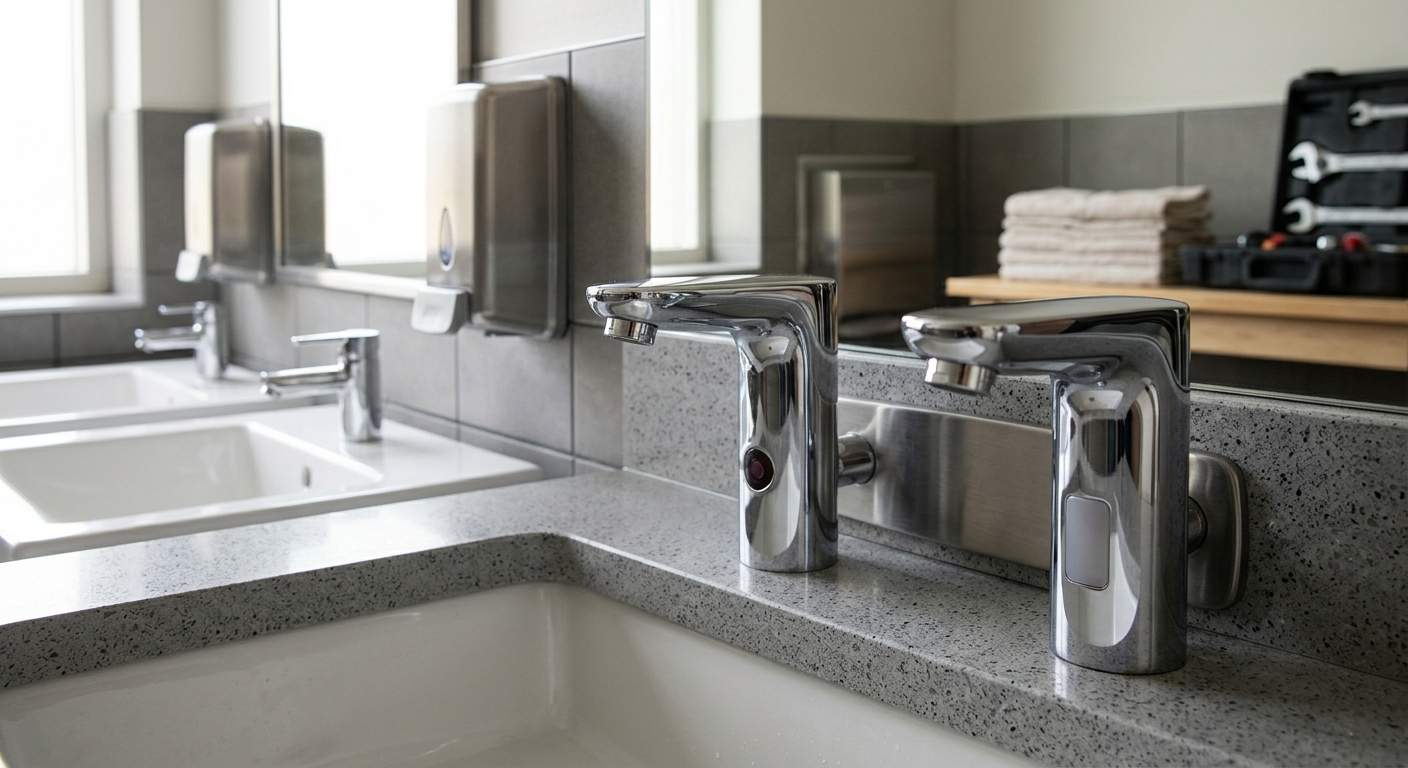
For most restroom retrofits, infrared is the safer default for faucets because it tolerates a wider range of basin materials and mounting depths without recalibration. Capacitive sensing earns its place where the faucet body is integrated into a solid-surface counter or where the spec calls for a sealed, no-gap sensor face. The harder question is not IR versus capacitive at the faucet alone. It is whether that choice holds up once you add a flush valve and a soap or towel dispenser to the same wall, the same power run, and the same field of detection.
IR vs Capacitive: How Each Detects Hands
Infrared faucet sensors emit a beam, typically in the 850-950nm near-infrared band, and read the reflection off a hand or object. The fixture’s control board measures return signal strength and timing to decide whether to open the solenoid valve. This is an active-emission system: it needs a clear optical path from emitter to target and back.
Capacitive sensors work differently. They generate a low-voltage electrostatic field around the sensing element and detect the change in capacitance when a hand (or any conductive mass) enters that field. No line of sight is required, which is why capacitive sensing can work through non-conductive basin material or a thin decorative panel. The tradeoff is that the field is shaped by whatever surrounds it, so mounting substrate and nearby metal matter more than they do with IR.
Detection Range and False-Trigger Risk by Type
IR faucet sensors are commonly tuned for a 4 to 6 inch detection range, close enough to avoid triggering on someone standing at the adjacent basin but far enough to activate reliably when a hand is placed under the spout. Range is adjustable on most commercial units, but every inch you add increases the chance of picking up movement outside the intended zone, especially in narrow trough sinks where basins sit close together.
Capacitive sensors do not have a “range” in the same sense since the field strength decays with distance rather than cutting off sharply. This makes them more prone to drift if the mounting surface changes (a wet countertop, a splash of soap, mineral buildup on a solid-surface deck) because all of those change the local capacitance the sensor is reading against. IR is more forgiving of surface contamination since it is reading reflected light, not electrical field, but it is more sensitive to strong ambient light sources near the basin, including some LED vanity fixtures and direct sun through a window.
- IR advantage: consistent range setting, less affected by splashing or residue on the sensor lens
- Capacitive advantage: can be mounted flush or hidden behind non-metallic material, no optical window to keep clean
- IR risk: false triggers from reflective countertops or bright ambient light
- Capacitive risk: field drift from moisture, soap film, or nearby grounded metal (a stainless basin lip, for example)
Powering a Mixed Sensor Restroom Consistently
Every electronic faucet, flush valve, and dispenser in the room needs power from somewhere, and the two standard options are hardwired 6V DC (typically stepped down from a transformer, sometimes 12V DC on some flush valve platforms) or battery, usually 4x AA alkaline or a lithium pack rated for extended service life. The decision is not really about faucets in isolation. It’s about whether the whole room runs on one power philosophy or a mix.
Hardwired 6V DC systems cost more to install because they require low-voltage wiring runs to each fixture location, but they eliminate battery replacement rounds across dozens of fixtures in a commercial restroom. Battery-powered units are faster to install and retrofit into existing walls with no conduit, which is why they dominate renovation jobs where opening walls is not in the budget. Mixing the two in a single restroom is common but creates a maintenance record with two different service intervals: battery swap schedules for some fixtures, and essentially no scheduled service for others until a transformer or board fails.
If the facility already has a maintenance contract built around battery replacement cycles, matching every fixture in the room to battery power keeps that contract simple. If the project is new construction or a gut renovation where conduit is already open, hardwiring the whole room to a central 6V DC transformer removes battery replacement from the maintenance plan entirely and is usually the lower long-term labor cost.
Avoiding Cross-Talk Between Adjacent Fixtures
Cross-talk is the practical failure mode specifiers miss until commissioning. Two IR faucets mounted close together on a trough sink can pick up each other’s reflected beam if detection windows overlap, causing one faucet to activate when a hand is at the neighboring basin. Most commercial IR faucets allow range and sensitivity adjustment specifically to manage this, and the fix is usually narrowing the detection cone rather than repositioning hardware.
Capacitive fixtures have a different cross-talk problem: if two capacitive sensors are grounded to the same metal substrate (a stainless trough or a shared metal mounting bracket), the field from one unit can influence the baseline reading of the other, causing intermittent false triggers or dead zones. This is less about beam overlap and more about shared electrical reference. Isolating the mounting hardware or using manufacturer-specified spacing between units resolves most of this, but it needs to be checked at rough-in, not after tile is set.
The general spacing guidance from manufacturers for both technologies assumes clear countertop between basins. Trough sinks, ganged lavatories, and ADA-compliant accessible sinks placed close to a standard-height basin are the conditions that most often produce cross-talk complaints during commissioning.
Matching Sensor Type to Flush and Dispenser Units
Flush valve sensors are almost universally IR, reading a fixed detection zone in front of the valve body to trigger a flush when a user steps away. The detection geometry is different from a faucet (aimed outward and down rather than downward into a basin) but the underlying 850-950nm IR technology is the same, which matters for parts consistency and battery type across the room.
Soap and towel dispensers are available in both IR and capacitive versions, though IR dominates because dispensers are typically wall-mounted with a clear detection zone in front of the nozzle, similar geometry to a flush valve. Capacitive dispensers exist mainly in integrated countertop units where the dispenser is built into a solid-surface deck alongside the faucet, which is the one place capacitive genuinely earns a role beyond the faucet itself.
Standardizing on IR across faucet, flush, and dispenser gives a facilities team one detection technology to troubleshoot, one battery type to stock if the room is battery-powered, and one set of adjustment procedures. Mixing IR faucets with capacitive dispensers is workable, but it means two calibration procedures, two spare parts lists, and two ranges of failure symptoms to diagnose when something misfires.
Spec Checklist for Whole-Room Sensor Consistency
| Decision Point | Question to Answer Before Ordering |
|---|---|
| Power source | Is the whole room hardwired 6V DC, all battery, or a defined mix with a documented reason? |
| Sensor type per fixture | Are faucet, flush, and dispenser sensor types matched, and if not, is the mismatch documented for the maintenance team? |
| Mounting substrate | For capacitive units, is the mounting material non-conductive and consistent across all basins? |
| Basin spacing | Does trough or ganged basin spacing meet the manufacturer’s minimum clearance to avoid cross-talk? |
| Detection range setting | Has IR range been set and tested on-site rather than left at factory default, especially in trough configurations? |
| Code compliance | Do faucet fittings meet ASME A112.18.1 / IAPMO PS standards for electronic lavatory faucets? |
Before finalizing a mixed-sensor restroom, walk the room layout with basin spacing, wall power runs, and fixture cut sheets in hand rather than specifying faucet, flush, and dispenser separately from three different catalogs. Confirm the manufacturer’s minimum spacing for IR units in any trough or ganged configuration, and confirm capacitive units are only used where the mounting substrate is documented as compatible. Where the building already has a battery-replacement maintenance contract in place, match every electronic fixture in the room to that power type rather than introducing a hardwired subset that gets serviced on a different schedule. If the retrofit involves opening walls for other trades, that is the point to evaluate whether a full hardwired 6V DC run pays for itself over the battery alternative across the fixture count in the room.
