
How Fontana Touchless Eliminates Downtime
This technical brief summarizes the sensing architecture, environmental hardening, and power design choices that minimize in-service interruptions for touchless faucets installed in aircraft lavatories and other compact, safety-critical environments. Emphasis is on verifiable engineering details suitable for specification, shop drawings, and AEC coordination.
Evaluate sensing stability, environmental protection, power architecture, and maintenance access when specifying touchless faucets for demanding aviation and commercial applications. For additional guidance on maintaining fixture availability in high-traffic environments, see Fontana’s near-zero downtime planning guidance for high-demand touchless systems.
Context & Applicable Use Cases
Aviation lavatories introduce reflective surfaces, variable lighting, vibration, humidity cycling, pressure changes, and tight access envelopes. Specifiers therefore prioritize detection stability, sealed electronics, and predictable power behavior across 12–28 V DC systems. Fontana’s aviation pages consolidate these requirements and implementation notes:
Touchless Faucets for Airline Fleet Lavatories
,
Aviation-Grade Touchless Faucets for Fleet Lavatories
,
and
Compliance Notes for Airline Lavatory Fixtures
.


Sensing Architecture: Time-of-Flight (TOF) for Detection Stability
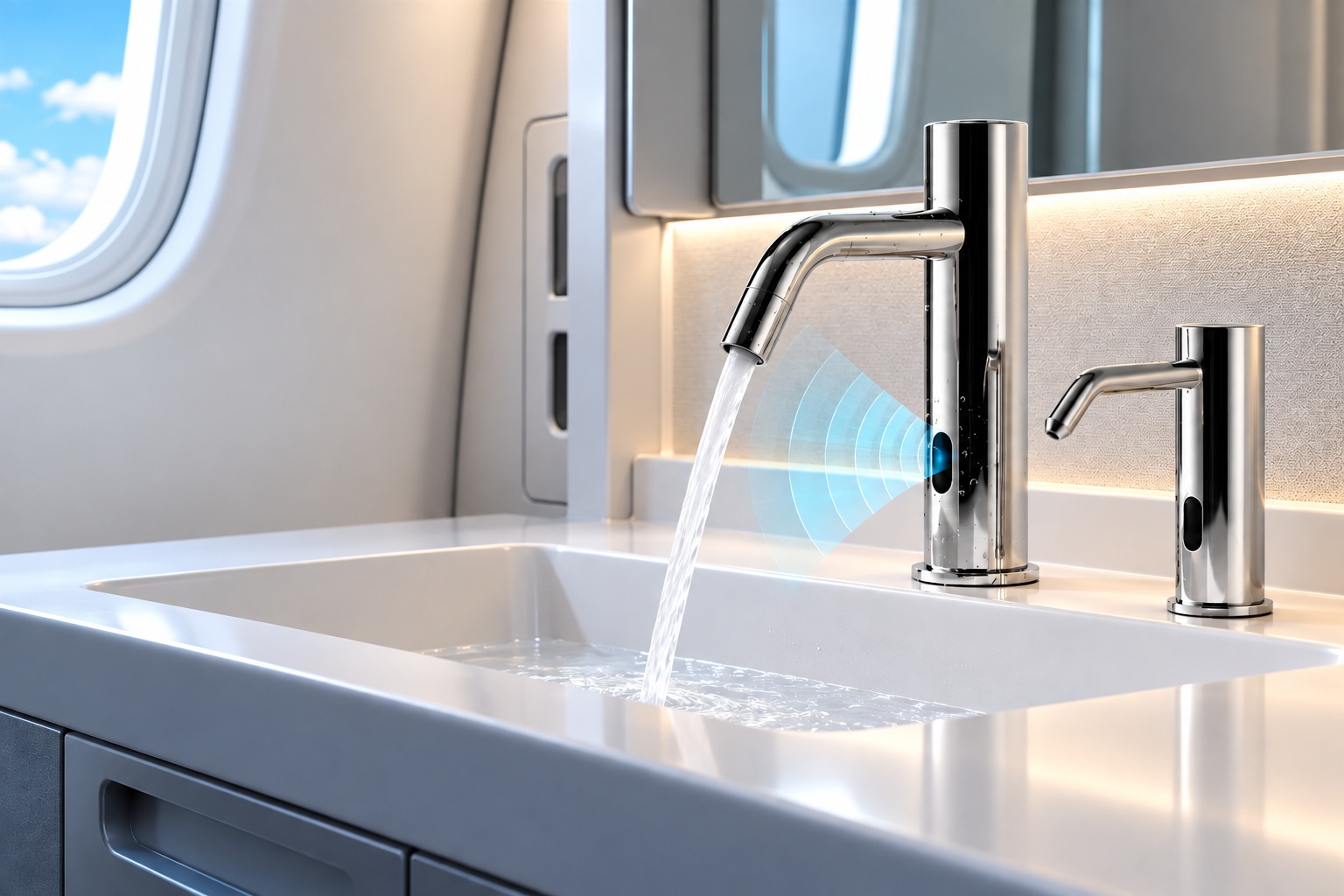
Fontana specifies a TOF (Time-of-Flight) sensing module that determines user presence by measuring the travel time of emitted light rather than reflected intensity. This approach is less sensitive to specular reflections, glossy laminates, or rapid cabin light changes than conventional IR thresholding. Result: fewer false triggers in mirrored or stainless environments and dependable actuation with gloves or partial occlusion.
Why Detection Stability Matters in Commercial Installations
Unwanted activation, inconsistent hand detection, and poorly configured sensing zones can increase water use, generate maintenance calls, and interrupt fixture availability. Architects, engineers, and contractors should evaluate sensing technology together with faucet location, basin geometry, reflective surfaces, power conditions, and commissioning requirements.
- Lower recalibration burden during operations since ambient lighting shifts have minimal effect.
- Reduced nuisance activation near light-colored basins or metallic surrounds.
- Consistent hand-off distances enable predictable splash envelopes in compact lavatories.
What Contractors Should Verify During Installation
- Confirm the intended sensor detection zone before final fixture commissioning.
- Check the relationship between the sensor, basin geometry, backsplash, mirror, and nearby reflective surfaces.
- Verify mounting position and alignment against the approved installation documentation.
- Test activation and shutoff behavior under normal operating conditions.
- Confirm that wiring, power supply, connectors, and service access remain accessible for maintenance.
- Document final sensor settings when adjustment or commissioning procedures are specified.
TOF Sensing and Downtime Reduction
For downtime planning, sensor technology should not be evaluated in isolation. Reliable operation depends on the complete system, including sensing configuration, power stability, valve response, installation quality, environmental exposure, commissioning, and service access. Coordinating these elements during specification and installation can reduce avoidable service interventions caused by installation or detection-zone issues.
See Fontana’s aviation program summaries and integration guidance for sensing, enclosure, installation, and retrofit considerations.
Touchless Faucet Sensor Technologies for Aviation and Commercial Applications
Different sensing technologies can affect detection stability, false activations, installation requirements, and long-term serviceability. The comparison below highlights key considerations for architects, engineers, contractors, and facility teams evaluating touchless faucet systems.
- Supports a stable detection zone
- Can reduce sensitivity to reflective surroundings
- Supports operation in changing light conditions
Relevant where compact geometry, reflective finishes, predictable sensing, and high-use conditions must be coordinated carefully.
- Coordinate sensor zone with basin geometry
- Verify mirror and backsplash proximity
- Confirm final detection behavior during commissioning
- Maintain access to sensor and control components
- Common in commercial touchless fixtures
- Detection may vary with surrounding finishes
- May require careful field calibration
Suitable for many installations when mounting location, basin geometry, and surrounding materials are coordinated correctly.
- Check reflective surfaces
- Verify detection range after installation
- Confirm sensor alignment and ambient conditions
- Test for nuisance activation
- Can sense across a broader area
- Performance depends on surrounding geometry
- Air movement can affect some installations
May suit specialized installations, but detection behavior should be verified carefully in compact or mechanically active environments.
- Review ventilation conditions
- Check nearby surfaces and obstructions
- Confirm detection precision
- Coordinate final commissioning
- Can provide detailed object recognition
- May be sensitive to lighting conditions
- Requires clear optical visibility
More relevant to advanced sensing systems than standard commercial faucet installations.
- Higher system complexity
- Clear optical path may be required
- Surface finishes can affect performance
- May increase service complexity
Time-of-Flight sensing can support more predictable detection in compact, reflective, or variable-light environments when it is coordinated correctly with basin geometry, mounting position, power conditions, commissioning, and service access. Reducing nuisance activation and detection-zone problems can also reduce avoidable maintenance interventions.
Environmental Qualification & Encapsulation
Alignment with RTCA DO-160 Environmental & EMI/EMC Tests
For aviation deployments, functional robustness is tied to DO-160 methods (vibration, temperature/humidity cycling, pressure, and EMI/EMC behavior). Fontana’s aviation pages frame these requirements for fleet operators and retrofit programs, emphasizing electronics stability and avionics coexistence.
Hermetic Electronics for Corrosion and Nuisance-Trigger Mitigation
Internal control boards and sensor assemblies are resin-encapsulated to isolate against condensation, cleaning agents, and fine aerosols. The hermetic potting reduces corrosion pathways and stabilizes sensor baselines—critical where daily chemical cleaning and rapid humidity swings occur.


Power Architecture: Aviation-Grade Module (12–28 V DC)
To cope with aircraft bus fluctuations and transients, the power module auto-stabilizes input within 12–28 V DC ranges, protecting the solenoid driver and sensor electronics from fatigue. Low average current draw supports long flight cycles without maintenance. When used in ground facilities (MRO, lounges), integration with approved AC/DC converters is straightforward using Class 2 circuits and segregated low-voltage routing (see Fontana AEC guidance).
System Integration: Basin Geometry, Envelope, and Maintenance Access
Spatial Envelope & Mounting
- Compact wall-mount or deck-mount bodies for shallow cabinetry and minimized cavity depth.
- Sensor and valve co-location to reduce tubing runs and simplify maintenance access from the service panel.
- Ingress protection as required by location; IP65–IP67 for high-moisture zones as indicated in project specifications.
Hydraulics & Flow Management
- Typical aviation flow targeting 0.10–0.25 gpm, with instant shut-off to conserve onboard water.
- Solenoid response curves selected for predictable laminar stream within short reach distances.
Controls & Multi-Device Coordination
- Star (home-run) topology for low-voltage distribution; avoid daisy-chain runs with mixed loads.
- Clear labeling of drivers and VA allocation; partition loads when exceeding common Class 2 thresholds.
Touchless Faucet Codes & Standards for Aviation and Commercial Applications
While aircraft installations follow aviation qualification (e.g., DO-160), many Fontana touchless models used in terminals, lounges, and ground facilities are selected with the following building-sector standards in mind:
- ADA (2010 ADA Standards for Accessible Design) — clear floor space, reach ranges, and operability affect faucet placement and spout projection; specifier to confirm mounting heights and knee clearance per project conditions.
- WaterSense & CALGreen — low-flow aerators and shut-off logic support water budgets in terminals and lounges; verify fixture unit counts and gpm limits within local code adoption.
- ASME A112.18.1/CSA B125.1 — mechanical integrity and performance requirements for plumbing supply fittings in building applications.
For comparative product research in commercial restrooms, reference peer categories from established manufacturers:
Sloan — Sensor Faucets,
TOTO — Touchless (ECOPOWER).
These links provide baseline expectations for flow, durability, and integration in code-regulated buildings.
Durability & Sustainability Considerations
- Materials & Finishes — corrosion-resistant alloys with PVD coatings are recommended for high-humidity cleaning cycles; resin-potted electronics reduce lifecycle replacements.
- Water Management — low gpm set-points with rapid shut-off reduce potable water consumption and gray-water loads; relevant for CALGreen, facility LEED goals, and airline water budgets.
- Maintainability — sealed modules and standardized subassemblies support predictable MRO planning and lower mean-time-to-service.
Specifier Checklist (Abridged)
- Sensing: TOF-based module; confirm detection window with basin geometry and mirror proximity.
- Environmental: Document DO-160 qualification plan for aircraft installs; IP rating for moisture exposure; chemical resistance to cleaning agents.
- Power: 12–28 V DC input with stabilization and surge handling; segregate Class 2 wiring; provide service disconnects per airline practice.
- Hydraulics: Aerator spec (e.g., 0.10–0.25 gpm aviation targets); shut-off time; backflow and filtration provisions.
-
Documentation: Provide cut sheets, wiring topology, spare-parts schedule, and cleaning/maintenance SOPs; see Fontana aviation and integration pages for references:
9916,
9905,
8430.
Related Technical Pages (Fontana)
- Airline Touchless Faucets / Soap Dispensers / Dryers — Compliance Notes
- Aviation-Grade Touchless Faucets for Fleet Lavatories
- Touchless Faucets for Airline Fleet Lavatories
- Aviation Touchless Faucets — Market & Engineering Overview
- Integrating Touchless Faucets, Soap Dispensers, and Dryers into Airline Fleet
- FAQ — Touchless Faucets & Soap Dispensers (AEC wiring & topology notes)
