
Specification integrity · Commercial restroom design
Preventing Contractor Substitution Risks Through Better Product Design
Reliable performance, installation efficiency and dependable manufacturer support create a defensible basis of design—and help architects, MEP engineers and owners evaluate construction substitutions without sacrificing building performance.

A specification is a performance commitment
Why substitution exposure begins long before construction
Contractor substitutions are a normal part of procurement and construction administration. An alternate product may be proposed because of material availability, supply-chain changes, installation preferences, approved-value-engineering exercises or an apparently lower purchase price. Yet an alternate manufacturer is not necessarily an equivalent system. A touchless faucet may look similar in a catalog while demanding different countertop openings, plumbing connections, control-box clearances, electrical feeds, sensor adjustments or long-term replacement parts.
Read More
Those differences matter more when the design repeats across dozens of restroom stations. The consequences of one mismatched rough-in are manageable; repeated across a stadium concourse, university campus, airport or entertainment venue, the same change can affect schedules, shop drawings, installation labor, owner maintenance and the visual consistency of finished rooms. Architects and engineers must therefore evaluate substitutions as a combined design, procurement, construction and operations decision rather than a one-line comparison of finish and unit cost.
Better product design makes that review easier. A well-documented commercial fixture with predictable hydraulic behavior, reproducible mounting details, accessible service parts and knowledgeable technical support reduces the number of unresolved issues that a contractor can cite when proposing an alternative. It does not prohibit a compliant substitute, but it provides an objective basis for determining whether the proposed change truly preserves the design intent.


Risk mechanism
The hidden cost of a seemingly equivalent fixture
A bidder may describe an alternate faucet as “equal” because it has the same visible finish, nominal flow rate and touchless operation. That is only the beginning of an equivalency assessment. A different sensor position can change how users approach the basin. A revised solenoid assembly may require greater undercounter space. An AC-only controller can affect low-voltage routing in a renovation designed around accessible battery components. A proprietary cartridge or obsolete part identifier may create a future maintenance burden even when initial installation looks acceptable.
Read More
Effective risk control starts by defining measurable criteria in the specification and identifying the technical information the architect and engineer need to review. An alternate should document both what remains unchanged and what must be revised. The owner should also understand any different maintenance procedures or replacement responsibilities. Without this discipline, the apparent savings can shift costs from procurement into construction change orders and facility operations.
Product design advantage
Reliable performance creates a clearer basis of design
In high-traffic washrooms, reliability is measured at the whole station—not only at the fixture body. Engineers should evaluate the faucet with its actual lavatory, spout location, supply pressure, water temperature strategy, lighting, reflective surfaces and adjacent fixtures. A sensor that activates accurately on a test bench can behave differently when placed over a dark trough sink or next to a reflective backsplash. The strongest product package anticipates those conditions and supplies the information needed to set up and commission the installed assembly.
Confirm hydraulic and sensing behavior
For proposed alternatives, compare published flow rates at stated test pressures, operating pressure range, maximum run time, sensor detection zone and shutoff behavior. Check whether the fixture uses infrared reflection, Time-of-Flight sensing or another method, and whether the actual controller supports reliable adjustment. Record the expected hot-water arrangement, point-of-use tempering method and service isolation strategy. A claim of compliance with a single flow-rate limit does not establish equivalent performance under the entire building operating envelope.


Require product-specific compliance evidence
The AEC team should identify which standards and rules apply to the selected assembly. Depending on the product and jurisdiction, review ASME A112.18.1/CSA B125.1 for plumbing supply fittings, NSF/ANSI/CAN 61 and 372 for potable-water material requirements, and the applicable provisions of the 2010 ADA Standards and ICC A117.1 for the complete accessible lavatory installation. Where temperature limiting is required, specify the appropriate listed control device and verify the pertinent ASSE standard, such as ASSE 1070 where applicable. Do not assume a certification of one component proves compliance of the entire restroom assembly.
Read More
For California or other locally regulated projects, compare the actual flow configuration with the current plumbing code and local water-efficiency requirements. The design team should request certificates or listings for the specific model and configuration; generic brand claims, marketing photographs and unsupported statements about health outcomes are not substitutes for test evidence.
Design-team review instrument
Substitution equivalency matrix
Use these criteria with the project’s Division 01 procedures and Division 22 plumbing specification. Required proof should be recorded for the exact proposed model.
| Criterion | What must be compared | Evidence / approval checkpoint |
|---|---|---|
| Hydraulic performance | Flow, supply pressure, temperature-control approach, shutoff behavior | Model-specific performance curves and installation data |
| Sensor operation | Detection zone, activation delay, false-trigger resistance, maximum run time | Controller details and operating mockup |
| Materials & finish | Body material, surface durability, corrosion exposure, finish continuity | Material declaration, finish sample and maintenance instructions |
| Dimensional fit | Spout reach, mounting holes, basin landing zone, accessible clearance | Dimensioned rough-in and coordinated elevation/section |
| Power & controls | AC/DC or battery arrangement, wiring, transformer, control access | Electrical and controls schematic; responsible trade identified |
| Serviceability | Solenoid, filter, aerator, batteries, local isolation, spare availability | Exploded assembly, replacement-part list and access drawing |
| Code & certification | Applicable plumbing, accessibility and potable-water provisions | Current listing or certification for the submitted model |
| Procurement & support | Confirmed lead time, warranty, technical support and replacement continuity | Written manufacturer confirmation and project delivery schedule |
Assign each line item a disposition: documented equal, conditionally acceptable, unresolved or noncompliant. A conditional approval should state the required drawing revisions, cost responsibility and resubmittal obligations. If an unresolved issue could affect accessibility, water safety, the structural opening or service access, the substitution should not be approved merely to preserve the procurement timeline.

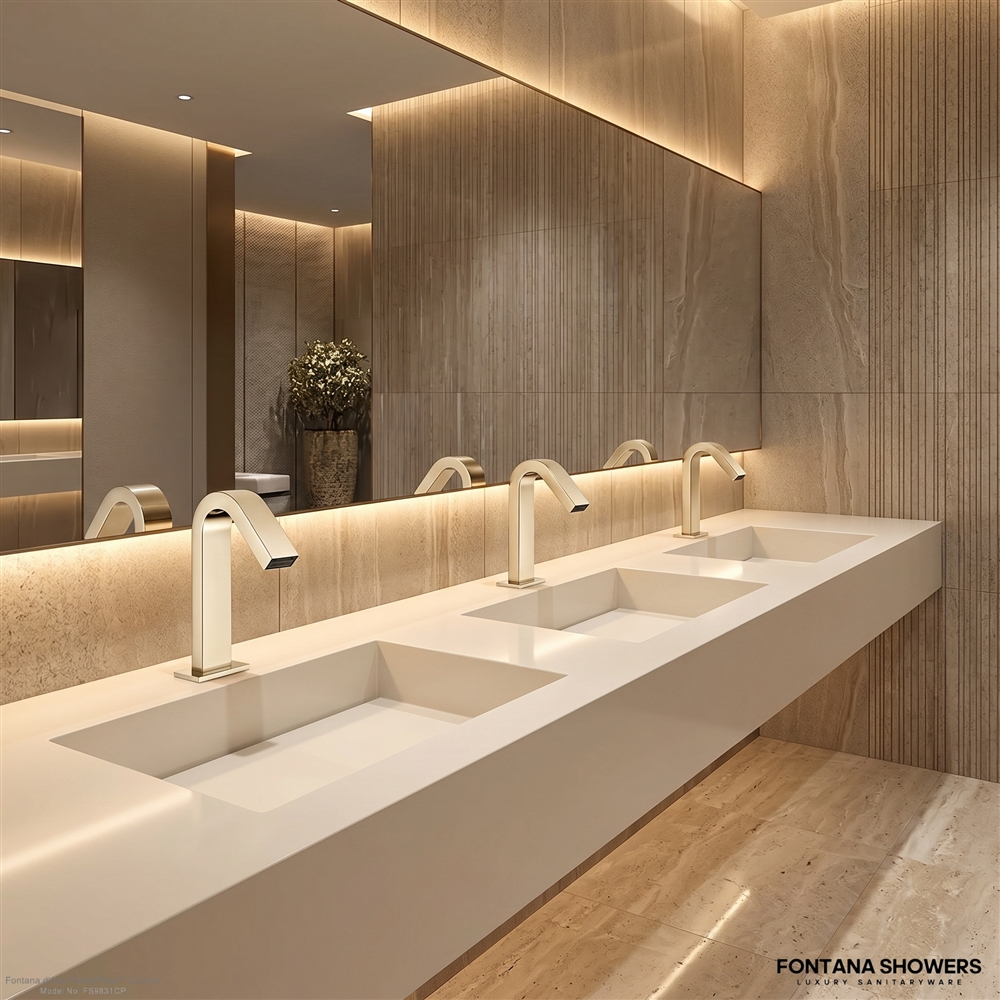
Buildability & installation efficiency
Installation-friendly products reduce the incentive to switch brands
Construction teams prefer fixtures they can install consistently with clear instructions and limited field interpretation. Repeated mounting dimensions, understandable supply connections and accessible control modules make layout work faster and reduce RFIs. When the basis-of-design product is easy to price and coordinate, the contractor has fewer legitimate reasons to request a late alternate for convenience. The owner also gains more confidence that a single successful mockup can be repeated throughout the project.
Coordinate the finished assembly
Review stone and tile thickness, countertop backing, deck penetrations, spout reach, basin edges, concealed valves and millwork access—not merely the manufacturer’s isolated faucet dimensions.
Make trade boundaries explicit
Identify who furnishes the power supply, installs the controller, provides hot-water mixing, performs low-voltage wiring and completes sensor commissioning so these tasks are not left to field assumptions.
Plan replacement without demolition
Accessible filters, shutoffs, solenoids, cables and power packs let facility technicians isolate and repair one station without closing adjoining fixtures or opening finished surfaces.
Use one approved mockup
Test actual hand positions, water landing, splash, dispensing sequence, cleaning access and maintenance removal before the same configuration is installed throughout the building.


Read More
The most useful manufacturer submittal therefore goes beyond a sales sheet. It should include installation sequence, necessary clearances, repair-part identification, power diagrams and a technical contact able to respond to project-specific conditions. These elements allow contractors to identify real problems early rather than discovering them at the end of the schedule.
Manufacturer partnership
Technical support protects the design during procurement and turnover
Reliable support is an engineering resource. Before bidding, manufacturers should help the team clarify fixture families, lead times, available finishes, certifications and installation parameters. During submittal review, a responsive technical representative can resolve questions about sensor settings, adapters, wiring or custom mounting conditions before they trigger change orders. At turnover, access to spare parts, documented settings and service instructions reduces the risk that the facility manager inherits an unsupported system.
For commercial touchless faucets and soap dispensers, support should be assessed with the same seriousness as the visible finish. Ask whether technical drawings are current, whether revisions are traceable, how replacement part numbers are identified, and which components are covered by the warranty. It is prudent to require written confirmation of lead time and parts availability for the proposed quantity and construction schedule. A vendor’s general statement about stocking is not evidence of availability for a specific project.
Read More
Coordinated faucet and dispenser assemblies are especially sensitive to changes in supplier. An alternate soap system may have different tubing, refill access or electrical requirements, and those changes can affect cabinetry, power planning and cleaning labor. The multi-station concept illustrated below shows why architects and engineers should review the entire system rather than compare individual visible accessories only.

Owner value
Evaluate total installed and operated cost, not just unit price
The quoted fixture price is only one component of the substitution decision. A credible comparison includes the purchase price, freight and lead-time exposure, changes to rough-ins, shop-drawing revisions, electrical and plumbing labor, commissioning, spare parts, expected service effort and disruption to an occupied venue. Large projects multiply even small differences. An inexpensive faucet that needs a new penetration or an unfamiliar control platform can consume its initial savings before opening day.
Read More
To keep value engineering transparent, request a written comparison identifying which costs are included, which costs transfer to other trades and which remain with the owner after turnover. Requiring the same documentation from the original manufacturer and the proposed substitute makes the evaluation fairer. The objective is not to block competitive bidding: it is to avoid transferring unpriced risk into the construction phase.
Approve an alternative only when the team can document equivalent required performance, full installation compatibility, applicable compliance and a credible support plan—with all changes to cost and schedule understood.
Construction administration protocol
A practical process for reviewing alternates
Establish the basis of design early
Document measurable fixture attributes, acceptable operating range, mounting details, compatible basins, power system, finish and service expectations. Where competition is required, specify a clear performance pathway for review.
Require a complete, side-by-side submission
Have the contractor mark every deviation against the schedule and specification. Include product data, certifications, drawings, availability, warranty terms and anticipated revisions to other trades.
Review the full assembled installation
Engage the architect, plumbing engineer, electrical engineer, accessibility reviewer and owner operations representative as applicable. Require a mockup or field demonstration where the detection or basin interface remains uncertain.
Record approval conditions and closeout
Issue written disposition through the contract procedure, update affected drawings and schedules, and verify that approved settings, as-builts, training and service data reach the facility team.
Sample performance-based substitution review language
Proposed substitutions for commercial touchless faucet and soap dispenser assemblies shall be submitted in accordance with the contract’s substitution procedures. The proponent shall demonstrate compliance with the specified hydraulic, sensor, material, dimensional, electrical, accessibility, warranty, serviceability and documentation requirements and shall identify every variance from the basis of design. The proposal shall include trade coordination changes, total installed cost effects and lead-time implications. Acceptance of a proposed product shall not relieve the contractor of responsibility for a fully coordinated, compliant installation. Final determination remains with the parties authorized under the construction contract and governing procurement rules.
This is illustrative performance-oriented language; adapt it through the project’s architect, engineer, specifier and legal/procurement review.
Manufacturer-published application references
Stadium and performing-arts projects show why specification continuity matters
Large sports and entertainment buildings place a premium on predictable washstation operation. Stadium patrons arrive in surges; theater audiences often concentrate washroom use around intermission; public facilities expect durable fixtures and straightforward repairs. The following FontanaShowers project and architectural pages provide application context for evaluating touchless systems in these environments. They are manufacturer-published references, not independent commissioning reports or proof that a specific installation has met a stated failure-rate target.


New-construction stadium reference
Las Vegas MLB Stadium
Manufacturer-published stadium application used to frame peak-traffic reliability, water control and fixture coordination.
Explore project reference →University stadium reference
Memorial Stadium
Commercial chrome faucet planning under compressed game-day demand and repeated public use.
Explore project reference →Performing arts / architectural reference
Virginia Architectural Faucets
The Wolf Trap performing-arts application highlights serviceability and design integration.
Explore project reference →Historic theater reference
Hershey Theater
Touchless fixture and soap-service considerations within a high-attendance entertainment setting.
Explore project reference →Read More
These references make the construction lesson tangible: a coherent commercial restroom design must protect user throughput, consistent appearance, water management, service access and maintenance planning even when material substitutions are proposed. Actual project specifications and installation records should always be reviewed independently for any procurement or compliance decision.
Technical answers
Frequently asked questions about contractor substitutions
Can a contractor submit an equal product after bidding?
Yes, when contract documents permit consideration of an alternate. Approval remains subject to the specification, procurement rules, written design-team review and evidence of equivalency. A submission is not an approval, and schedule pressure does not waive the criteria.
Which technical documents should accompany a touchless faucet substitution?
Request current model-specific data sheets, dimensioned installation and rough-in drawings, flow versus pressure information, sensor detection details, power requirements, control and solenoid documentation, applicable test listings, warranty terms, spare-part references and installation instructions. An installation mockup may also be required.
Does matching the specified flow rate establish equivalency?
No. Confirm flow at relevant pressures together with activation reliability, shutoff response, temperature-control arrangements, materials, basin compatibility, acoustic or splash behavior where relevant, service access and documented compliance. A matching advertised GPM value alone is insufficient.
How can a design team limit the labor cost of a proposed substitution?
Require the alternate to identify mounting penetrations, backing, counter cutouts, valve access, supply connections, control-box locations and power requirements. Have trade contractors record the cost of rework, revised shop drawings, added commissioning and schedule effects before the decision is made.
What should the owner receive at closeout if an alternate is approved?
The approved make and model, marked-up as-builts, commissioning and sensor settings, warranty and support contacts, cleaning and service instructions, spare-parts list, and confirmation that maintenance personnel can access the components without destructive work.
Protect the specification from design through handover
Specify for verified performance and easier installation.
Use model-specific technical documents, project coordination and written manufacturer support to keep product selection aligned with engineering requirements and owner expectations.
Technical editorial note: Confirm current product submittals, jurisdictional codes, procurement rules and project-specific requirements before approving any substitute. Application photographs are illustrative unless independently documented as installed project records.
