
Architectural Specification Insights
Code‑compliant, sustainable, and reliable restroom systems — a deeper technical overview for architects and specifiers.
Evaluate compliance, water efficiency, serviceability, and documented performance criteria before specifying restroom fixtures for commercial, healthcare, hospitality, and institutional projects.

The Architecture of Compliance: Understanding cUPC, NSF, and WaterSense
For commercial, institutional, and hospitality projects, fixture selection is inseparable from compliance. The combined framework of cUPC, NSF/ANSI 61, NSF/ANSI 372, and EPA WaterSense defines potable‑water integrity, material health, and efficiency.
Compliance Framework
- cUPC: Conformity assessment verifying hydraulic performance, backflow prevention, and installation integrity — IAPMO Certification & Testing.
- NSF/ANSI 61: Health‑effects limits for leachates in wetted materials — NSF/ANSI 61 Overview.
- NSF/ANSI 372: Low‑lead compliance (≤ 0.25%) — ANSI on NSF/ANSI 372.
- WaterSense: EPA efficiency + performance labeling — EPA Product Specifications & Technical Specifications.
These standards align with LEED v4.1 Indoor Water Use Reduction, the WELL Water concept (WELL Features), and California’s CALGreen provisions, providing a clear, reviewable path through plan check and inspection.
Specifying for Performance: Engineering Faucets for High‑Traffic Environments
Spec‑grade performance is defined by endurance, control fidelity, and maintainability under real‑world conditions — frequent use, variable pressures, and rigorous cleaning.
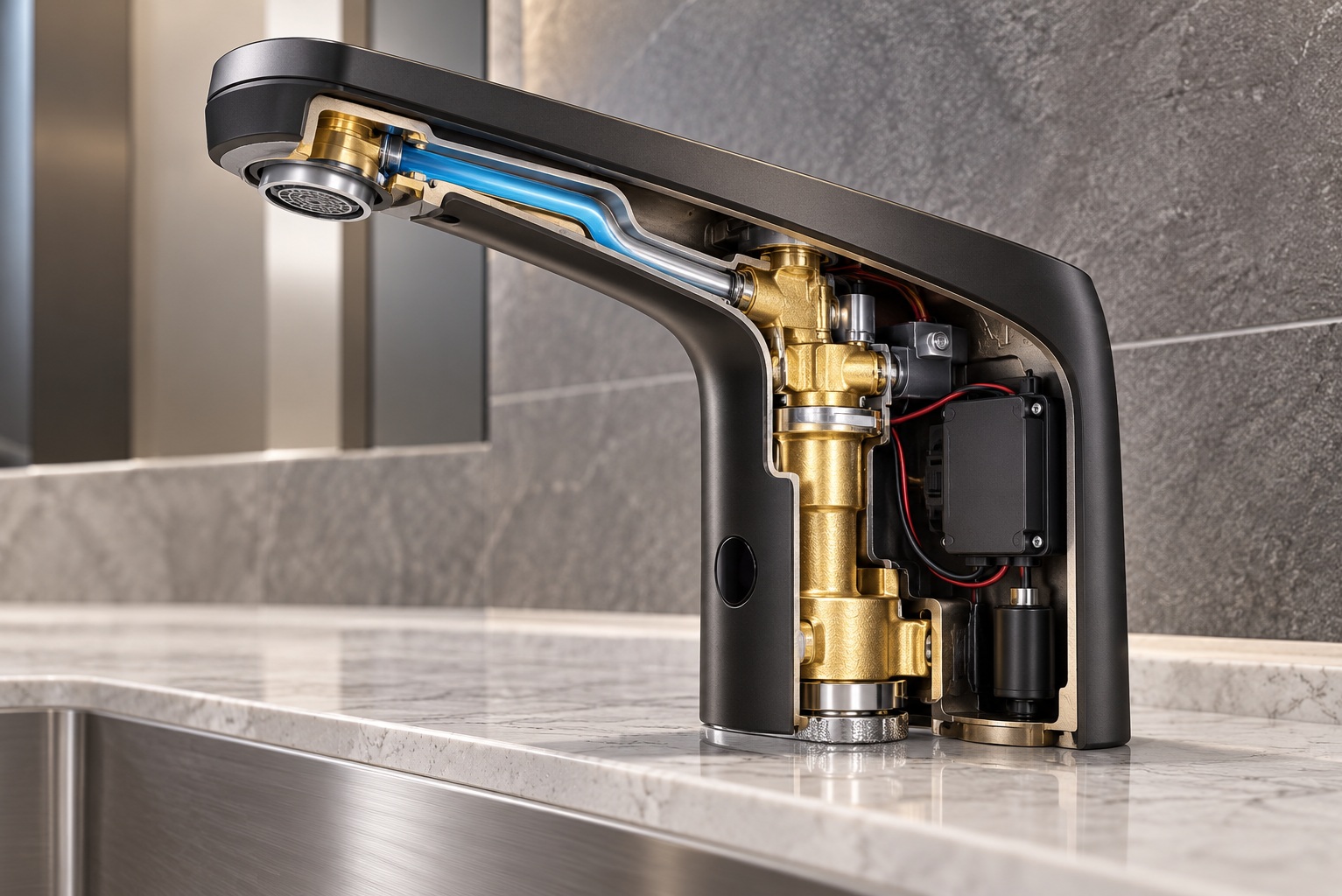
Engineering Criteria
- Structure: Solid brass bodies; industrial‑grade solenoids; finishes validated by salt‑spray and abrasion testing.
- Controls: Adaptive infrared sensing tolerant of reflective finishes and ambient light; failsafe timeout; anti‑flood logic.
- Reliability: Endurance testing often exceeding 500,000 activations; thermal/pressure shock validation; ingress protection for electronics.
- Serviceability: Modular internals (sensors, solenoids, cartridges) replaceable without disturbing finished surfaces to reduce MTTR.
BIM object libraries and documented pressure/flow envelopes improve coordination with MEP design, sizing upstream valves and ensuring stable delivery at the point of use.
Designing for Public Health: Low‑Lead & Touchless Technologies
Material health and hygienic interaction are fundamental to public infrastructure. Low‑lead alloys certified to NSF/ANSI 372 help protect water quality, while touchless activation reduces fomite transfer on shared touchpoints and supports infection‑control strategies.
System Guidance
- Water Quality: Maintain delivery and backflow control per the Uniform Plumbing Code and state adoptions. Reference lavatory clearances: ADA/Access Board Guide and the 2010 ADA Standards.
- Hygiene: Encourage proper handwashing with CDC guidance.
- Legionella Risk: Coordinate controls with building water management per CDC: WMP Overview and Toolkit PDF.
Timed shut‑off, periodic purge modes, and pressure‑compensating aerators help limit stagnation and aerosolization concerns in intermittent‑use or seasonally vacant areas.
Sustainable Water Management: Integrating WaterSense Fixtures
Public lavatory faucets delivering ≤ 0.5 GPM support commercial water-efficiency goals and can contribute to indoor water-use reduction strategies under LEED v4.1 WE and applicable CALGreen requirements.
Specification Levers
- Calibrated aerators and pressure‑compensating regulators stabilize flow under supply variance.
- Adaptive shut‑off logic prevents unintended discharge and curbs waste.
- Lifecycle‑minded components reduce replacement frequency and material throughput across portfolios.
When scaled across multi‑site programs, fixture‑level optimizations deliver meaningful potable savings and lower hot‑water energy use, supporting organizational ESG performance.
The Specifier’s Guide to Reliability: Code-Compliant, Future-Ready Systems
Reliability emerges from documented compliance, robust engineering, and maintainable assemblies. Faucets documented for applicable cUPC, NSF/ANSI 61, NSF/ANSI 372, water-efficiency, accessibility, and project-specific requirements can support code coordination and specification review, while thorough documentation (certificates, product data, BIM) helps streamline plan check and substitution review.
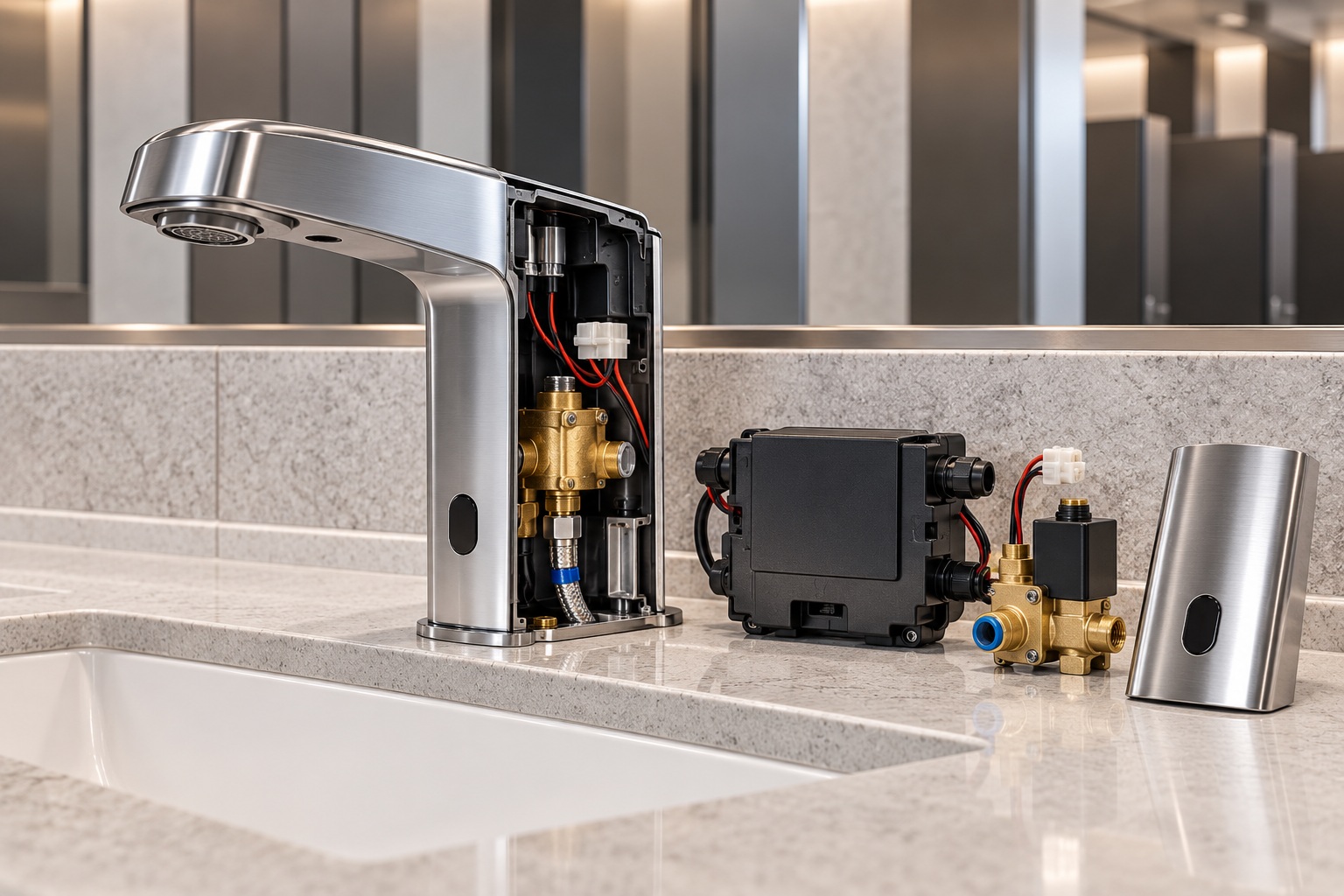
Coordination & Delivery
- Modular assemblies simplify service and standardize detailing across roll‑outs.
- BIM/Revit resources support interdisciplinary coordination and clash detection.
- Defined pressure/flow envelopes aid upstream sizing and predictable performance.
Resilient systems conserve resources, reduce operational risk, and improve user experience over the building lifecycle.
Key References (Verified)
- EPA WaterSense – Product Specifications
- EPA WaterSense – Bathroom Faucets
- NSF/ANSI 61 – Drinking Water System Components
- NSF/ANSI 372 – Lead Content Overview (ANSI)
- IAPMO – cUPC Certification & Testing
- USGBC – LEED v4.1 Indoor Water Use Reduction
- IWBI – WELL Building Standard Features
- CALGreen – Title 24, Part 11 (ICC)
- CDC – About Handwashing
- CDC – Legionella Water Management Toolkit
Conclusion
From compliance to sustainability, performance, and reliability, faucet specification synthesizes engineering and design responsibility. The parameters reviewed—cUPC, NSF/ANSI, WaterSense, and low‑lead compliance—define fixtures not as accessories but as integral building systems. BathSelect.com adapts those principles for architects seeking clear, code‑aligned guidance across commercial, hospitality, education, and healthcare programs.
Commercial Faucet Specification: Final Review for Architects & Specifiers
A commercial touchless faucet should be evaluated as part of the complete restroom system rather than as an isolated fixture. Final selection should align documented compliance, hydraulic performance, sensor reliability, accessibility, water-efficiency objectives, maintenance access, and long-term serviceability with the requirements of the project.
Compliance & Documentation
Confirm applicable cUPC, NSF/ANSI 61, NSF/ANSI 372, accessibility, plumbing-code, and project-specific documentation before approving the final fixture or an alternate product.
Performance & Coordination
Review flow rate, operating pressure, sensor behavior, power strategy, basin geometry, mixing requirements, and rough-in conditions with architectural and MEP documentation.
Serviceability & Lifecycle
Prioritize accessible sensors, solenoids, control modules, strainers, and replacement components so routine maintenance can be completed without disturbing finished restroom construction.
Final specification check: Do not approve a touchless faucet solely on appearance, finish, or nominal flow rate. Verify the complete documented system, including compliance, material construction, power, sensing, service access, spare-part support, and compatibility with the intended commercial restroom application.
Compliance Framework Engineering Performance Public Health Water Management Reliability & Serviceability Verified References
