Technical Study Reference

Technical Study Reference — Touchless & Sensor-Driven Systems
Technical Study Reference

A U.S.-Based Research Framework for Touchless and Sensor-Driven Systems

Neutral, research-driven guidance for evaluating touchless and sensor-based systems using measurable metrics, structured testing methodology, and U.S. standards alignment.

Standards-aligned evaluation Metrics-first reporting Touchless modality coverage
Purpose

Purpose of This Reference

Research framework workspace showing calibrated measurement instrumentation and standards traceability for touchless system evaluation.

This Technical Study Reference establishes a neutral, research-driven foundation for understanding, evaluating, and documenting touchless and sensor-based systems for engineering and operational decision-making.

Scientific principles
Measurement methodologies
Performance metrics
Environmental variables
U.S. regulatory and standards alignment
Scope

Definition of Touchless Systems (Technical Scope)

Layered touchless system architecture diagram showing sensing acquisition, inference processing, actuation control, and human factors constraints.

A touchless system detects human presence, motion, proximity, or intent and initiates a response without physical contact between the user and the interface.

Sensing layer: hardware capturing IR, RF, acoustic, or optical depth signals
Signal processing & inference layer: algorithms converting raw signals into interpretable events
Control & actuation layer: logic triggering dispensing, lighting, or interface actions
Human factors layer: usability, safety, accessibility, and error prevention requirements
Modalities

Touchless Sensing Modalities

Sensor modality comparison view showing PIR, ultrasonic, radar, ToF depth, and vision-based sensing pipelines for touchless interaction.

Touchless sensing technologies exhibit different strengths and limitations depending on environment, use case, and regulatory constraints.


Passive Infrared (PIR)

PIR sensors detect changes in infrared radiation caused by moving heat sources, typically the human body.

Effective for motion-based occupancy detection
Limited sensitivity to stationary presence
Strong dependence on mounting geometry and line-of-sight

Ultrasonic Sensors

Ultrasonic sensors emit high-frequency acoustic waves and analyze reflections to infer motion or presence.

Detects small movements under suitable acoustic conditions
Sensitive to airflow, geometry, and surface absorption
Commonly deployed for indoor occupancy sensing

Microwave & Millimeter-Wave Radar

Radar sensors emit RF energy and analyze reflections to detect motion, range, and micro-movements.

High sensitivity to micro-motion signatures, including respiration-scale movement
Operates without visible illumination and through some non-metallic materials
Requires compliance with U.S. spectrum and emissions rules

Active Infrared Proximity Sensors

Active IR uses an emitter/receiver pair to measure reflected infrared light from nearby targets.

Common actuation trigger for touch-free hygiene dispensers
Short-range detection envelope with rapid response behavior
Performance varies with ambient illumination and target reflectance

Time-of-Flight (ToF) Depth Sensors

ToF sensors estimate distance by measuring the time delay of emitted light returning to the receiver.

Supports spatial mapping and gesture segmentation via depth reconstruction
Sensitive to multipath reflections, calibration drift, and ambient light
Requires system-level design for reliability under real deployment conditions

Vision-Based Systems

Vision-based sensing uses RGB or depth imaging combined with computer vision inference pipelines.

High information density for pose, gesture, and scene understanding
Privacy and data governance requirements increase system constraints
Performance strongly dependent on illumination, occlusion, and optics
Metrics

Core Performance Metrics

Performance characterization plots showing detection probability, latency distributions, and false activation rates across controlled distances.

Detection metrics

Detection range bounds and usable operating envelope
Field-of-view coverage under defined geometry
Detection probability at controlled distances and angles
Event-to-response latency measured as a distribution

Accuracy metrics

False positive rate for unintended activations
False negative rate for missed intended activations
Multi-user interference behavior under concurrent targets

Environmental robustness

Performance stability under varying illumination and glare conditions
Sensitivity to target reflectance and surface properties
Temperature and humidity drift characteristics
Electromagnetic interference tolerance in realistic installations

Application-specific metrics for hygiene dispensing

Dispense volume consistency across repeated activations
Output variance and repeatability over controlled trials
Mechanical degradation signatures over lifecycle usage
Testing

Testing Methodology

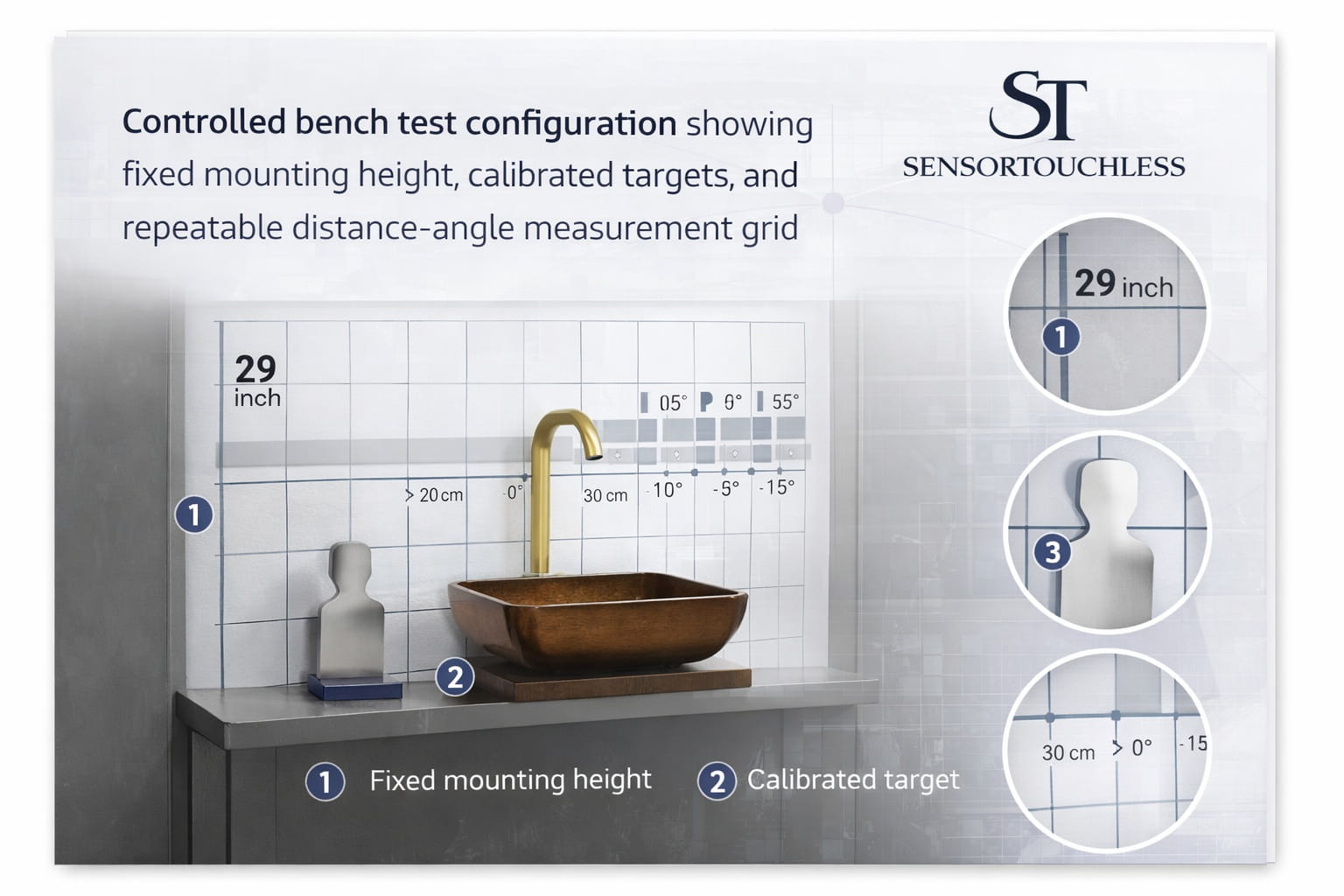
Controlled bench test configuration showing fixed mounting height, calibrated targets, and repeatable distance-angle measurement grid.

Controlled bench testing

Bench testing isolates sensor performance from user behavior and site variability.

Fixed mounting heights and standardized sensor orientation
Defined distance and angle grid for repeatable trials
Multiple target materials with documented reflectance properties
Controlled lighting conditions and exposure constraints
Distribution-based reporting for repeatability and variance

Field testing

Field testing validates performance under real operational conditions.

Ground-truth validation via manual observation or event logging
Testing across peak and off-peak usage conditions
Documentation of user approach behavior and interaction patterns
Alignment with clinical safety and infection prevention practices

Comparative evaluation

Identical installation geometry across systems
Equivalent environmental constraints and measurement conditions
Matched trial counts and consistent reporting structure
Clear limitations and replication notes for each comparison
Applications

Application Reference Areas

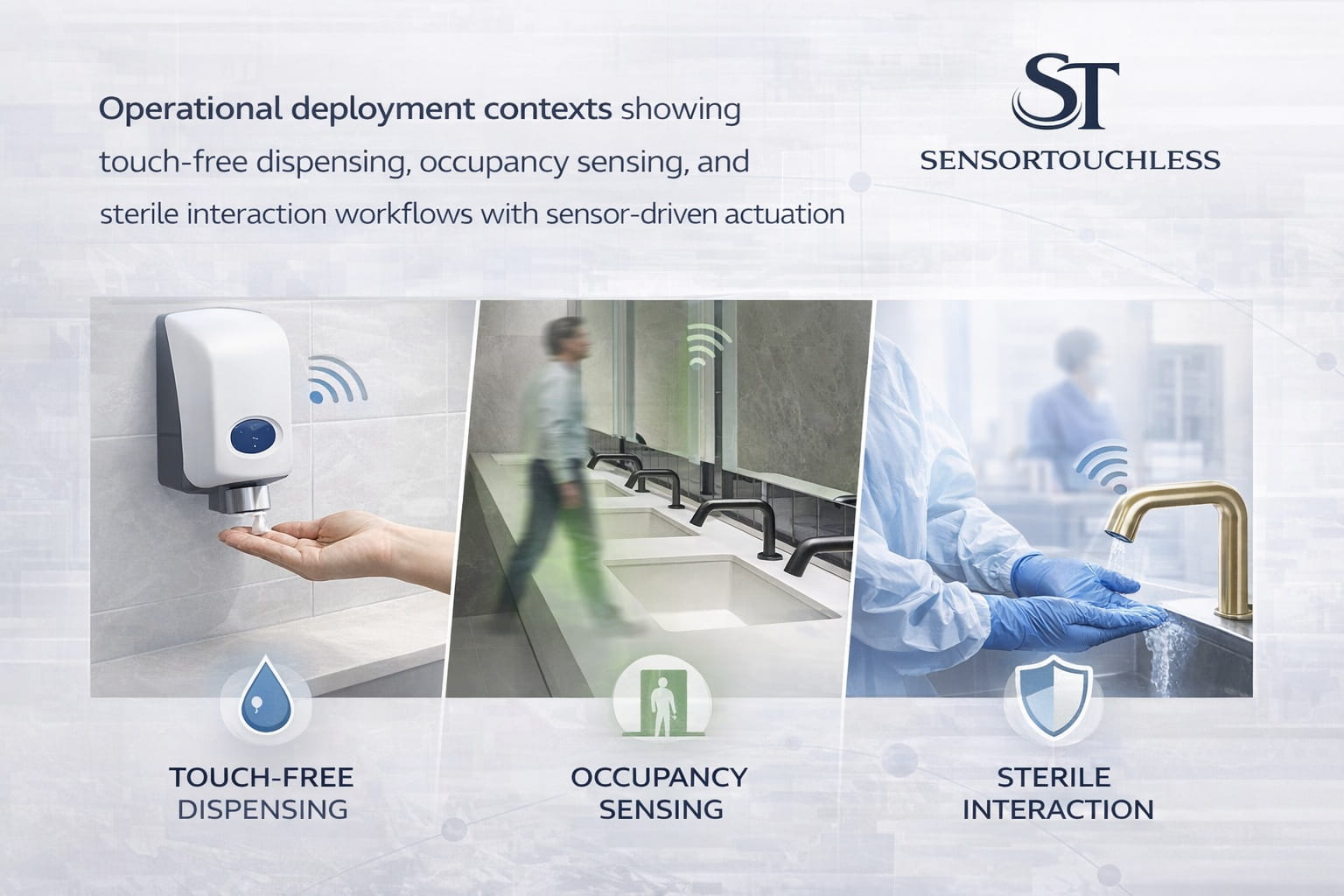
Operational deployment contexts showing touch-free dispensing, occupancy sensing, and sterile interaction workflows with sensor-driven actuation.

Hygiene and touch-free dispensing

Primary concern: reliable activation and consistent dose delivery.

Activation reliability under realistic approach trajectories
Dose repeatability and output variance across trials
Durability and performance drift under sustained usage

Occupancy and building controls

Primary concern: accurate detection without occupant discomfort.


Clinical and sterile interaction systems

Primary concern: enabling interaction without compromising sterility or workflow efficiency.


Radar-based presence detection

Primary concern: regulatory compliance and micro-motion sensitivity.

Standards

U.S. Regulatory and Standards Foundation
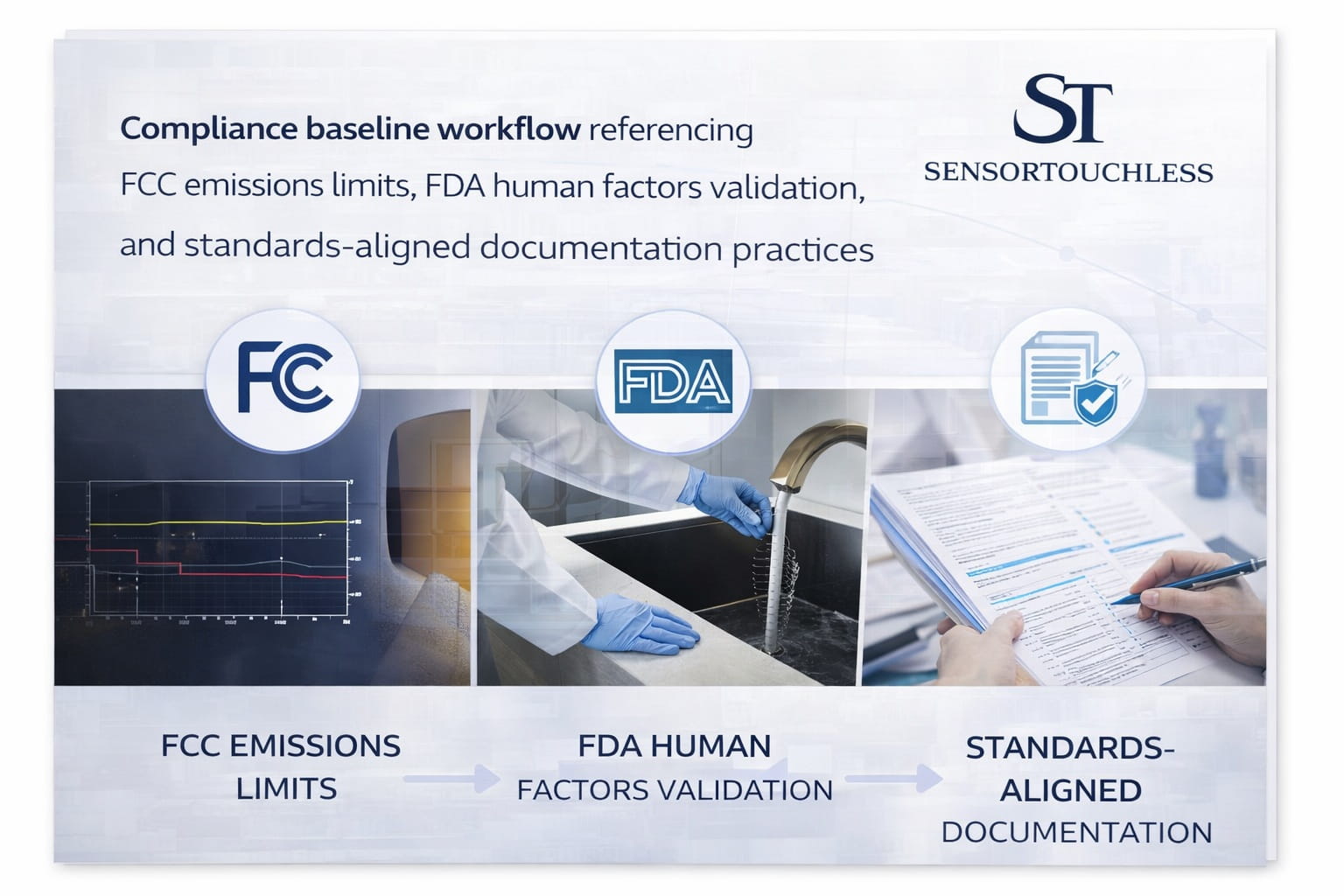
Compliance baseline workflow referencing FCC emissions limits, FDA human factors validation, and standards-aligned documentation practices.

This reference aligns with U.S.-based authorities that define technical and regulatory baselines for evaluating touchless systems across healthcare, public infrastructure, and building environments.

Federal Communications Commission (FCC)
U.S. Food and Drug Administration (FDA)
U.S. Department of Energy (DOE)
Centers for Disease Control and Prevention (CDC)
National Electrical Manufacturers Association (NEMA)
Failure patterns

Common Failure Patterns

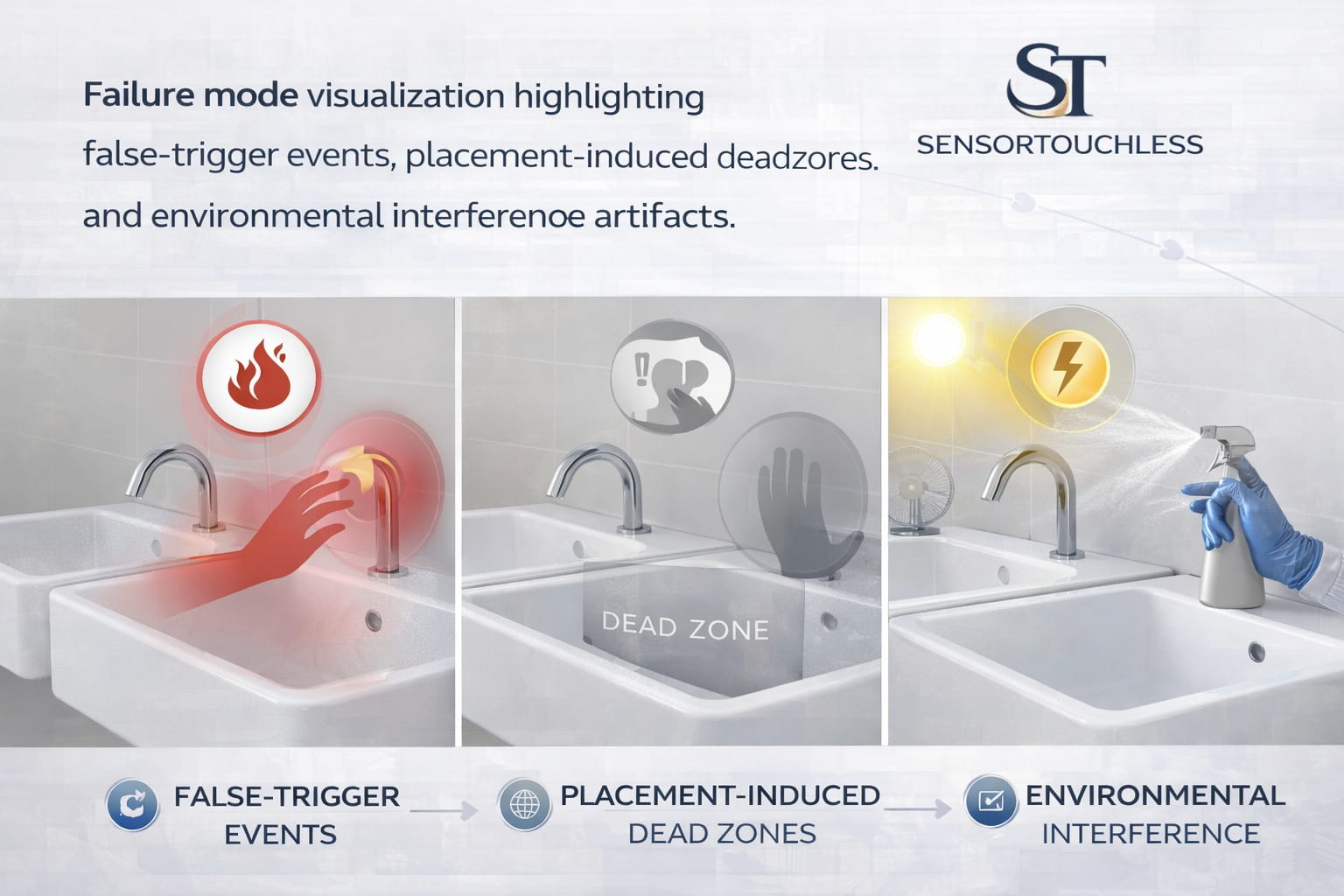
Failure mode visualization highlighting false-trigger events, placement-induced dead zones, and environmental interference artifacts.
Improper sensor placement resulting in coverage gaps or excessive triggers
Environmental interference affecting signal integrity and detection stability
Over-sensitivity tuning increasing false positives under noise conditions
Insufficient human factors validation in regulated or safety-critical workflows
Non-standardized testing that prevents reproducible performance claims
Reporting

Reference Reporting Structure

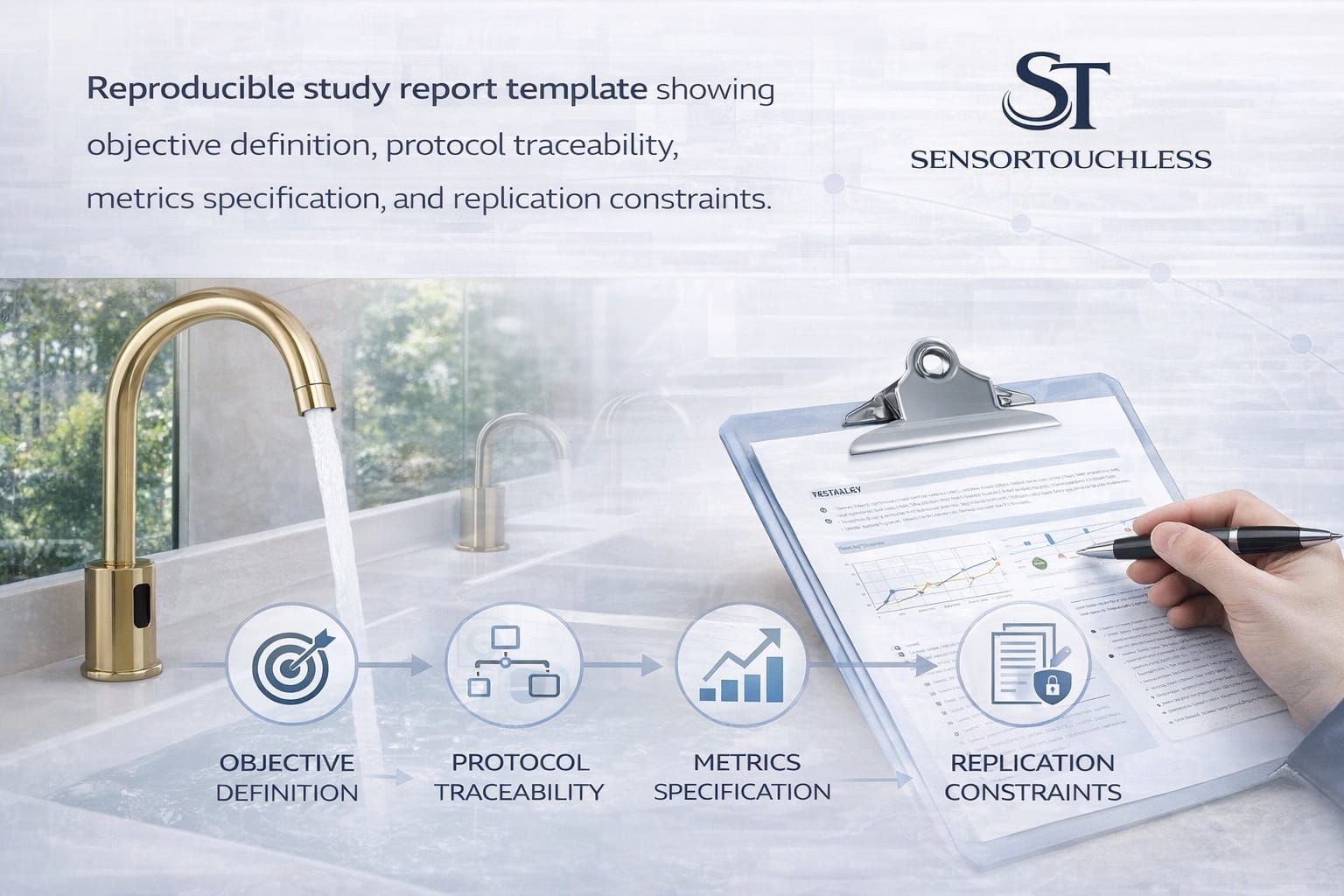
Reproducible study report template showing objective definition, protocol traceability, metrics specification, and replication constraints.

Each technical study published under this reference should include the following elements.

Objective and intended use definition
System description with sensor modality and installation geometry
Test methodology with controlled variables and trial design
Metrics reported with units, distributions, and confidence context
Results presentation and variance characterization
Limitations and known confounders
Replication notes and setup constraints
Source references and standards traceability
Conclusion

Conclusion

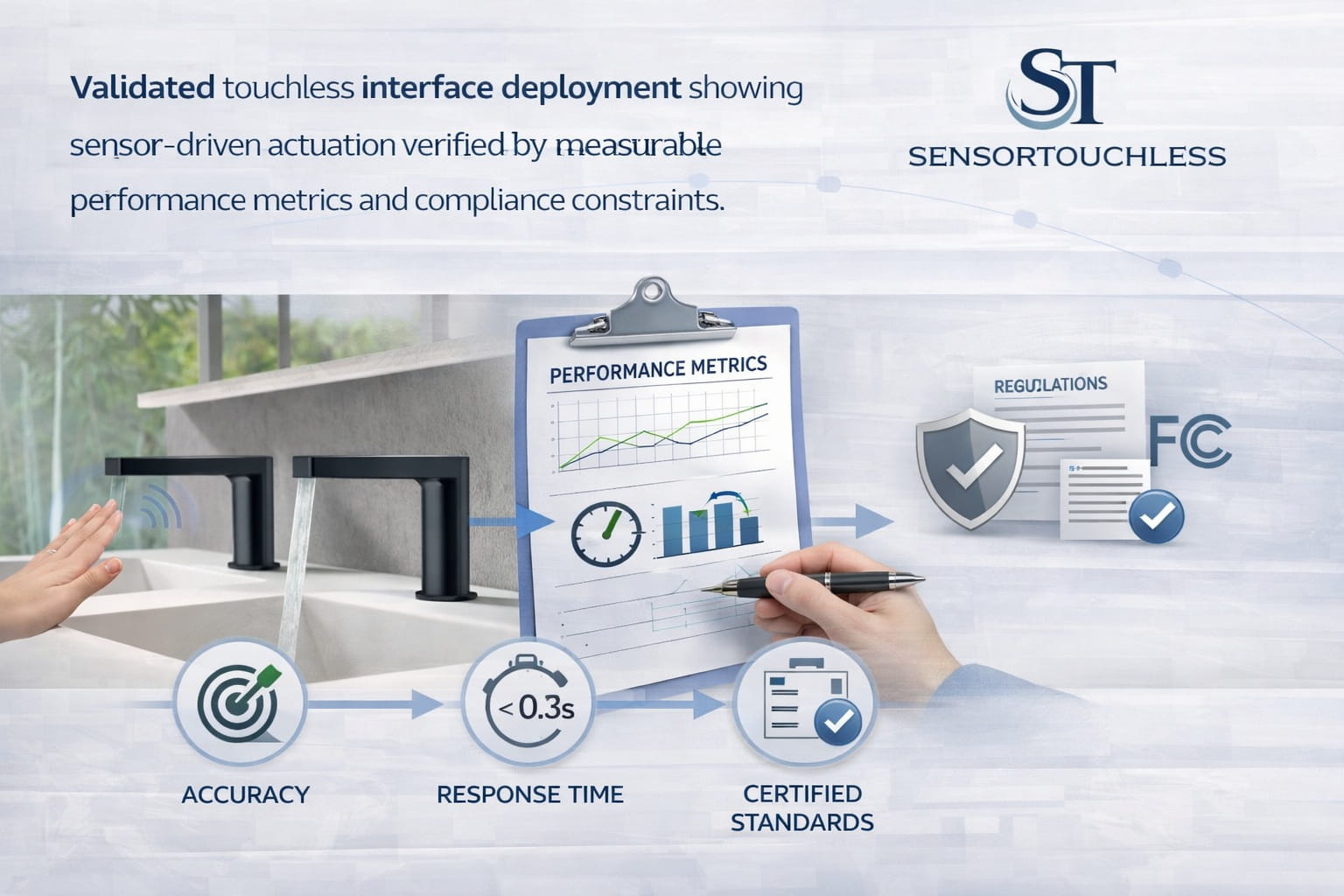
Validated touchless interface deployment showing sensor-driven actuation verified by measurable performance metrics and compliance constraints.

Touchless systems should be evaluated through measurable performance, usability constraints, and compliance, not novelty. This reference provides a consistent framework for interpreting studies and operational data using U.S.-based standards and reproducible methodology.

Future updates can extend this reference as new guidance, peer-reviewed studies, and field datasets become available.

© Technical Study Reference — Touchless & Sensor-Driven Systems