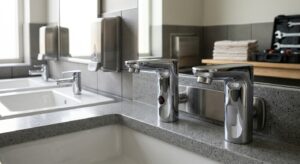
Yes, but treat it as a mechanical decision before a visual one. Minimalist sensor bodies and traditional bulkier ones differ in sensor range, mounting depth, and where the electronics live, which means mixing them works fine on faucets, flush valves, and dispensers only if each fixture’s housing matches what’s behind the wall or under the deck at that location.
Why Profile Shape Isn’t Just Aesthetic
A sensor fixture’s body has to hold three things: the sensor eye, the solenoid or valve mechanism, and the power source. Minimalist designs compress all three into a slim deck-mounted or wall-mounted shell, which usually means the electronics sit lower in the body or get pushed into a remote control box under the counter. Traditional profiles keep the sensor, valve, and battery or transformer stacked in one taller housing. Neither is “better” engineering, but they allocate space differently, and that allocation is what determines whether the fixture fits your rough-in.
Sensor Range Differences by Fixture Body
Faucet sensors typically detect at 4 to 6 inches (10 to 15 cm) from the sensor eye, regardless of body style, because that range is tuned to hand position at a lavatory, not body size. What changes with profile is sensor placement height and angle. A minimalist faucet with a low-profile spout often mounts the sensor closer to the deck, which can shorten effective range if the user’s hands sit higher than expected. Traditional bodies mount the sensor at a more consistent height on a taller spout, giving more predictable detection across different user heights.
Flush valve sensors read differently; they detect a user stepping away rather than a hand waving close. Range there is set by mounting height and valve body depth, and ADA placement rules intersect with this directly: operable parts, including flush actuators, need to fall within 15 to 48 inches of the floor. A minimalist flush valve with a recessed sensor can still meet that range, but installers need to confirm the sensor eye itself, not just the cover plate, sits in the compliant zone.
Mounting Depth and Deck Thickness Limits
This is where style choices turn into rough-in failures if ignored. Minimalist faucet bodies are built for thin decks, typically counters in the 3/4 inch to 1.5 inch range, because the slim shank has limited threaded length. Traditional bodies often ship with longer shanks and mounting hardware designed for thicker stone or solid surface decks up to 2 inches or more. If a specifier swaps a minimalist faucet onto a thick stone counter without checking shank length, the fixture may not seat, or the mounting nut runs out of thread before it’s tight.
The reverse problem happens with flush valves and dispensers mounted behind tile or marble wall panels. A traditional sensor flush valve expects a certain cavity depth for its battery pack or transformer; a minimalist version may need that same depth but relocates it to a remote junction box, which changes where the in-wall box has to sit. Confirm deck or wall thickness against the cut sheet before fixtures are ordered, not after tile is set.
Power and Battery Housing Constraints
AC transformer fixtures need a hardwired low-voltage line and a junction box, usually behind the wall or in a cabinet below the fixture. Battery-powered fixtures need only a cavity for the pack, but that cavity has to be sized for the battery count, commonly 4 AA or a single lithium pack depending on the model. Minimalist bodies tend to favor battery power specifically because it avoids the bulk of a transformer housing, which is also why battery life and replacement access matter more on these fixtures than on traditional ones.
Service access is the part that gets overlooked. A traditional faucet body often has a battery compartment accessible from above the deck, under the spout cover, so maintenance staff pull one cover and swap batteries without tools. Minimalist bodies frequently route the battery pack below the deck, inside the cabinet, which means maintenance needs access to the cabinet space and sometimes a specific wrench or quarter-turn fastener. If the restroom has no under-sink cabinet, as in many public ADA lavatories, that minimalist battery location is not serviceable without shutting down the fixture and working from below the counter in a crawl space. This is a real maintenance cost that doesn’t show up in the spec sheet dimensions.
Matching Profiles Across All Three Fixtures
For a single-system restroom, run the fixture set through the same four checks before locking the order:
- Deck or wall thickness: Confirm shank length or valve body depth against actual substrate thickness, not nominal counter spec.
- Power source and cavity: Match AC transformer fixtures to spaces with existing low-voltage wiring; match battery fixtures to spaces where service staff can reach the compartment without disassembly.
- Sensor height consistency: If faucets, flush valves, and dispensers are at noticeably different heights because of profile differences, users adjust their approach fixture to fixture, which shows up as nuisance activation or missed triggers.
- Service access plan: Decide who changes batteries and how often, then confirm the fixture’s access point matches that staffing reality.
For facilities standardizing on one vendor across the restroom, it’s worth reviewing a single product line’s full fixture set, including faucets, flush valves, and dispensers, so the sensor range, power options, and mounting specs are documented together rather than cross-referenced across three manufacturers. A line of commercial sensor faucets built for high-traffic use will usually list solenoid type and expected duty cycle on the same sheet as mounting depth, which saves a step when matching it against flush valves from the same catalog.
When to Mix Profiles Deliberately
Mixing is justified in a few specific cases. Retrofits where the flush valve rough-in is fixed and can’t be resized often call for a traditional flush valve body paired with a minimalist faucet at a new lavatory counter, since the two are on separate substrates with separate constraints. Facilities with no under-counter cabinet access should default to traditional faucet bodies with top-accessible battery compartments even if the rest of the restroom uses minimalist dispensers mounted where service staff already have a supply closet. The deciding factor is always physical access and substrate depth, not whether the two profiles look consistent next to each other.
What to Check Before Ordering
Pull the cut sheet for every fixture and compare four numbers side by side: minimum and maximum deck or wall thickness, sensor detection range, power source and cavity dimensions, and battery or transformer access method. If any fixture in the set requires access that the room’s finish plan doesn’t support, cabinet, service closet, or accessible panel, resolve that before fixtures ship. For ADA-governed restrooms, verify the flush valve sensor’s actual trigger zone, not just the cover plate, falls within the 15 to 48 inch operable-parts range. When in doubt on a retrofit with unknown wall cavity depth, have a plumber open an inspection point before fixtures are specified rather than after they arrive on site.